
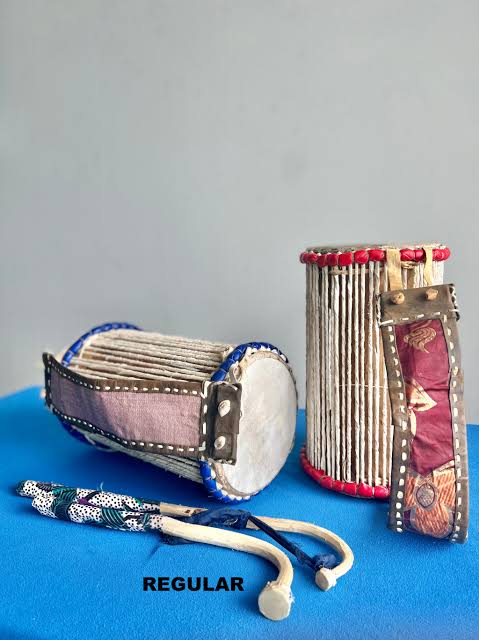
Talking Drums
Product Description
The talking drum is an hourglass-shaped drum from West Africa renowned for its unique ability to mimic the pitch, tone, and rhythm of human speech. Historically used for communication across vast distances, it remains a vital instrument in West African musical, cultural, and spiritual traditions today.
## How It "Talks"
The drum features two drumheads connected by a network of leather tension cords.
* The Mechanics: The player holds the drum under one arm (usually the non-dominant arm) and strikes one head with a specific curved stick. By squeezing and releasing the tension cords with their upper arm, the player alters the tension of the drumheads.
* The Speech Mimicry: Squeezing increases the tension, raising the pitch; releasing lowers it. Because many West African languages (such as Yoruba, Hausa, and Dagbani) are tonal—meaning the pitch of a word determines its meaning—a skilled drummer can replicate the tonal inflections, syllables, and rhythms of phrases so clearly that listeners can understand full sentences.
## Common Names across Regions
The talking drum is central to many ethnic groups, each with its own specific name for the instrument:
* Gangan: The Yoruba name (Nigeria/Benin), often considered the most widely recognized variant.
* Tama: Used by the Wolof and Serer peoples (Senegal/Gambia).
* Dondo: Used by the Akan and Ashanti peoples (Ghana).
* Kalangu: Used by the Hausa people (Northern Nigeria/Niger).
## Modern Context
While traditionally used to send messages between villages, praise royalty, or perform at ceremonies, the talking drum is now globally integrated into contemporary music. It is a foundational element in genres like Jùjú music and Afrobeats, and has been featured in modern film scores and orchestral arrangements worldwide.
Would you like to explore how the talking drum is used in traditional ceremonies, or are you interested in learning about other West African percussion instruments?
Register with us at www.deechordsmusical.com/register.